The Train You Can’t Get Off: Six Shooter and the 27-Minute DNA of Martin McDonagh
There are plenty of sensible ways into Martin McDonagh. You could start with The Beauty Queen of Leenane, graduate to In Bruges, and save The Banshees of Inisherin for a Sunday afternoon when you can cope with a donkey and an existential crisis. But the most efficient route is the one that takes 27 minutes and leaves you feeling as if you have been politely mugged on public transport.
Six Shooter, the short that won the Academy Award for Best Live Action Short Film in 2006, is twenty years old this year. It remains the cleanest, nastiest distillation of everything its writer-director does. If McDonagh’s feature films are elaborate meals and his plays are dinner theatre with a body count, Six Shooter is the amuse-bouche that tells you exactly what is in the kitchen. It is also, for anyone who has ever wondered what the fuss is about, the perfect place to begin.
A Masterclass in Horrible Small Talk
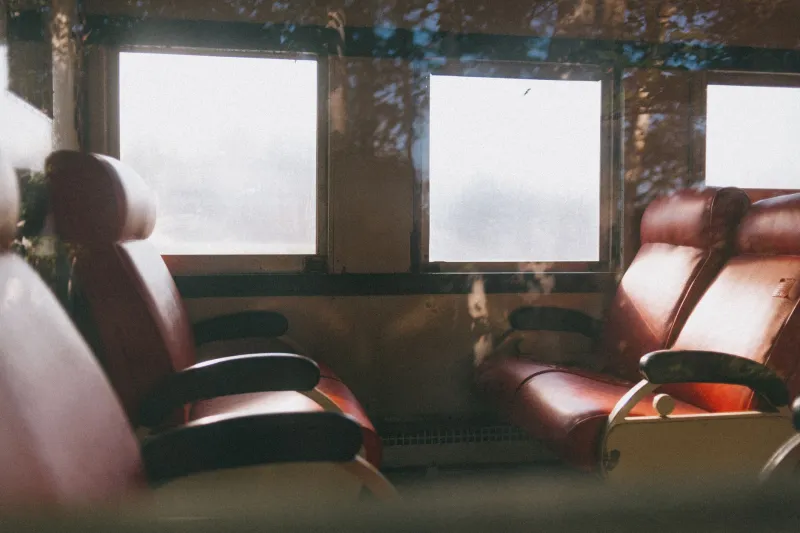
The setup is almost insultingly simple. Brendan Gleeson plays a recently bereaved man travelling by train. He wants silence, or at least the decency of being left alone with his grief. What he gets is Rúaidhrí Conroy as a young stranger who treats the carriage like a pub stool and Gleeson like a captive audience. The kid talks, and talks, and talks. He tells stories. He tests boundaries. He behaves like a man who has mistaken other people’s patience for a renewable resource.
Anyone who has endured a long journey next to an over-sharing stranger will recognise the texture immediately. The genius of Six Shooter is that it understands how quickly ordinary social discomfort can turn into something else. A train carriage is a small room with no exit. McDonagh has always loved a small room with no exit. Here, he strips it back to the studs: two men, a few bystanders, a window, a gun, and the terrible British-Irish politeness of not wanting to make a scene.
That politeness is the fuse. The film is not about a maniac leaping out of the dark. It is about what happens when someone decides that the social contract is optional and everyone else is too well mannered to stop him.
Grief, Guns and the Punchline That Won’t Land
What makes Six Shooter more than a nasty sketch is the grief underneath it. Gleeson’s character is not simply a straight man in a dark comedy. He is a man hollowed out by loss, riding a train because he has to be somewhere, carrying the sort of sadness that makes other people’s chatter feel like a personal insult. The young stranger senses that vulnerability and pokes at it. The result is funny, then uncomfortable, then frightening, then funny again in a way that feels faintly illegal.
That tonal tightrope is pure McDonagh. In Bruges gave us hitmen, guilt and a debate about purgatory; The Banshees of Inisherin gave us a friendship break-up with a body count; Hangmen gave us capital punishment and pub banter. Six Shooter is the short version of the same trick: it makes you laugh at something you know you should not, then makes you sit with the reason you should not. The punchline does not land so much as leave a bruise.
It also contains that distinctive McDonagh cruelty: violence arrives not with a fanfare but with a shrug, as if it were just another form of bad manners. A gun is not a symbol in this film. It is a gun. But the casualness with which it enters the conversation is more unsettling than any grand speech about morality.
Why It Works Better Than a Box Set
There is no fat on Six Shooter. No subplot about a magic flute. No film-star baggage. No need to remember which McDonagh brother directed which thing. It is a complete play with the boring bits removed, and its brevity is the point. In 27 minutes, you get the grief, the loquacious menace, the small-room claustrophobia, the suspicious attitude towards authority, the sudden violence and the lingering sense that the joke has been on you all along.
That is why it makes such a good introduction. If you have a friend who has never seen a McDonagh film and claims not to have the time, you do not need to sell them a three-hour epic or a trilogy about sheep. You need to sit them down with Six Shooter and watch their expression shift from amusement to alarm to reluctant laughter. If they enjoy that, they are ready for In Bruges. If they do not, you have lost 27 minutes and possibly a friend, but at least you know.
The Bridge Between the Plays and the Films
Six Shooter arrived after McDonagh had already made his name in the theatre with The Leenane Trilogy and The Pillowman. It was not the work of a beginner. It was the work of a writer testing whether his stage instincts could survive without a stage. And the answer was yes, rather thrillingly. The short film proved he could direct actors, control tone and trust silence. It also proved he could win an Oscar without making anything remotely Oscar-ish.
That matters because Six Shooter sits at the exact hinge between the playwright and the filmmaker. The dialogue is theatrical in its rhythm, but the close-ups do some of the work the audience’s imagination would do in a theatre. The train carriage is both a set and a cinematic space. You can see the future of McDonagh’s films in it: the love of confined spaces, the relish for awkward conversation, the suspicion that people are at their most dangerous when they are being friendly.
How to See It in the UK Now
Here is the mildly annoying part. Six Shooter is not sitting on the front page of a major UK streamer with a big red arrow pointing at it. It is a short film from 2006, which means it lives the itinerant life of an Oscar-winning extra. Your best bet is to look for it as a bonus feature on home releases of In Bruges, where it has often travelled as a supporting attraction. It also surfaces occasionally in curated shorts programmes, Oscar-themed cinema seasons and BFI Southbank-style screenings, so it is worth checking listings if you like your evenings to include a sense of impending doom.
For the streaming-minded, a quick search on JustWatch or a trawl through the more respectable rental platforms is sensible. Avoid the dodgy YouTube uploads with blown-out sound and Portuguese subtitles unless you are studying the film as a piece of internet archaeology. The sound mix matters here. So does the silence.
Twenty years on, Six Shooter remains a warning and an invitation. The warning is that Martin McDonagh will always find the joke in the worst possible moment. The invitation is simpler: get on the train. It only takes 27 minutes, and you will not forget the passenger in your carriage.