Fur, Feathers and Fatalities: Martin McDonagh's Animal Kingdom Always Gets a Raw Deal
Martin McDonagh has a body-count problem. Not the human one — we have all made our peace with that. It is the animals. In a McDonagh story, a person can be shot, bludgeoned, set on fire or simply talked to death, and the audience will chuckle into its gin and tonic. But let a cat go missing, a donkey swallow something it should not, or a small dog be bundled into a van, and the mood turns. Suddenly we are not watching a dark comedy. We are watching a hostage crisis with fur.
That is the strange magic of the McDonagh bestiary. Animals are never just set dressing. They are comic devices, moral barometers and, more often than not, the tragic victims of other people's grudges. They do not scheme, they do not hold forth about the Troubles, and they certainly do not write letters to the Irish Times. They simply exist, chew things and become collateral damage. And somehow their fates land harder than the human body count. The RSPCA would have a field day. The rest of us just sit there, laughing and then feeling slightly unwell about it.
The Cat That Launched a Thousand Gasps
Take Wee Thomas, the cat at the centre of The Lieutenant of Inishmore. On paper, the plot is about paramilitary lunacy, splinter groups and the sort of men who think a balaclava is a personality. In practice, the whole evening hinges on a cat. Wee Thomas is passed around, lied about and mourned with more sincerity than most of the human characters manage in a lifetime. The joke is obvious: a dead cat is treated like a fallen soldier, while actual people are dispatched with the shrug you might reserve for a parking ticket.
But McDonagh is not just being naughty. Wee Thomas is the play's emotional fuse. The cat is innocent in a way no human character can be, because everyone else is tangled up in ideology, ego or the desire to make a point. The cat just wants to be a cat. When its fate becomes the engine of the plot, the audience is forced to care about something that cannot argue back. It is a brilliant trick: make us laugh at the absurdity of a cat's death, then make us realise that the absurdity belongs to the humans, not the animal.
A Donkey, a Finger and the Limits of Forbearance
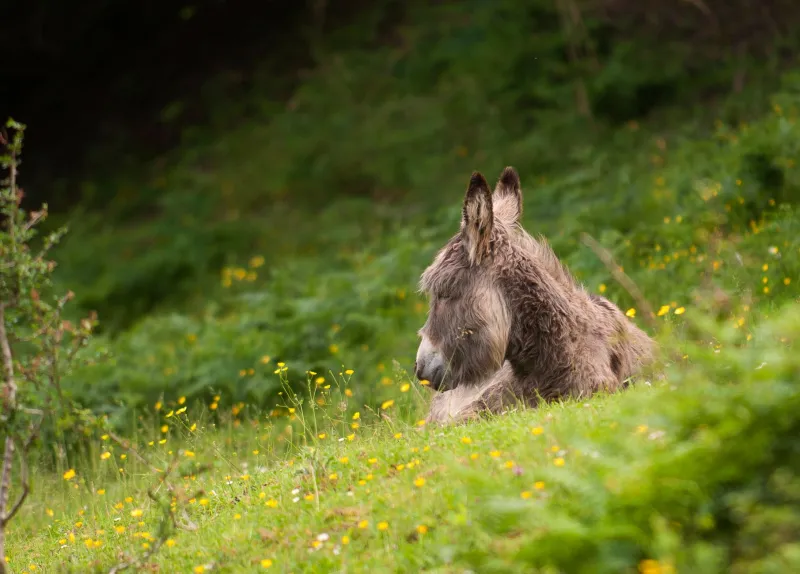
Then there is Jenny, the donkey in The Banshees of Inisherin. Jenny is not a comic prop. She is a roommate, a confidante and the only creature on the island who seems entirely unbothered by the male ego. Pádraic talks to her. She listens. She does not interrupt, which already puts her ahead of most of the cast. And then, because this is a McDonagh story, she meets a fate that is both ridiculous and genuinely upsetting: she swallows one of Colm's severed fingers and dies. It is the sort of plot development that sounds like a sketch from a very bleak children's programme. On screen, it is devastating.
What makes Jenny's death so effective is that it arrives after we have already been trained to laugh at the film's darker edges. The finger-lopping is grand guignol. The pub rows are comic theatre. But Jenny's death is not funny. It is the moment the film stops being a folk comedy about two stubborn men and becomes a tragedy about the collateral damage of pride. Pádraic's grief for the donkey is purer than his grief for his friendship. Why? Because Jenny never chose to hurt him. She never made a speech. She never cut anything off. She was simply there, and then she was not. If you have ever seen a British audience go quiet at a donkey's funeral, you know the power McDonagh is playing with.
Bonnie and the Art of the Kidnapped Shih Tzu
Seven Psychopaths takes the same instinct and gives it a Los Angeles suntan. The film is full of murder, mayhem and men monologuing about violence, but its most effective suspense sequence involves a small shih tzu called Bonnie. Bonnie is kidnapped, dognapped, used as leverage and generally treated like a furry bargaining chip. The humans around her are busy being quirky and homicidal. Bonnie is busy being a dog. And the audience, despite itself, cares more about her safe return than about half the people who end up dead.
This is the McDonagh animal trick in its purest form. The dog is a comic device — the sight of a tough guy cooing over a shih tzu is funny. But she is also a moral barometer. The characters who care about Bonnie are not necessarily good people, but they are at least capable of caring about something smaller and softer than themselves. The characters who threaten Bonnie reveal themselves as monsters. It is a neat bit of narrative shorthand: forget the body count, check who is nice to the dog.
Why the Animals Always Pay the Price
So why do McDonagh's animals hit harder than his humans? Part of it is innocence. In a McDonagh story, almost every person is complicit in something. They have grudges, resentments, petty cruelties and long memories. The animals do not. They are not part of the feud. They do not know what a cease-fire is. They have no opinion on the Anglo-Irish Treaty. They are just living their lives, and then a human decides to make a point.
Part of it is also theatrical contrast. McDonagh's humans talk. They talk beautifully, cruelly, funnily and at length. The animals do not talk at all. That silence makes them powerful. When a cat dies or a donkey chokes or a dog is stolen, there is no speech to explain it away. There is just the fact of it. The comedy stops. The audience is left with the uncomfortable realisation that it has been laughing at the build-up to something genuinely sad.
And part of it is simply that McDonagh knows how audiences work. We can forgive a man for shooting a policeman in a play. We can forgive a spot of arson, a bit of torture, a severed hand or two. But we are a nation of animal lovers, and we have strong views about cruelty to cats. McDonagh uses that. He makes us laugh at the human carnage, then makes us wince at the animal toll. It is not cheap. It is precision engineering.
Here at The McDonagh Files, we would never suggest that the man has it in for animals. He is simply using them as the cleanest moral mirror available. The humans are complicated. The animals are not. And when the animals suffer, we cannot pretend it is just a matter of politics, religion or a disagreement about fiddle music. It is just cruelty, plain and simple. The animals always pay the price because they are the price. And that is why, long after the human body count has become a punchline, we are still thinking about the cat, the donkey and the shih tzu.