A Pint of Irony: The Very English Cruelty of Martin McDonagh's Hangmen
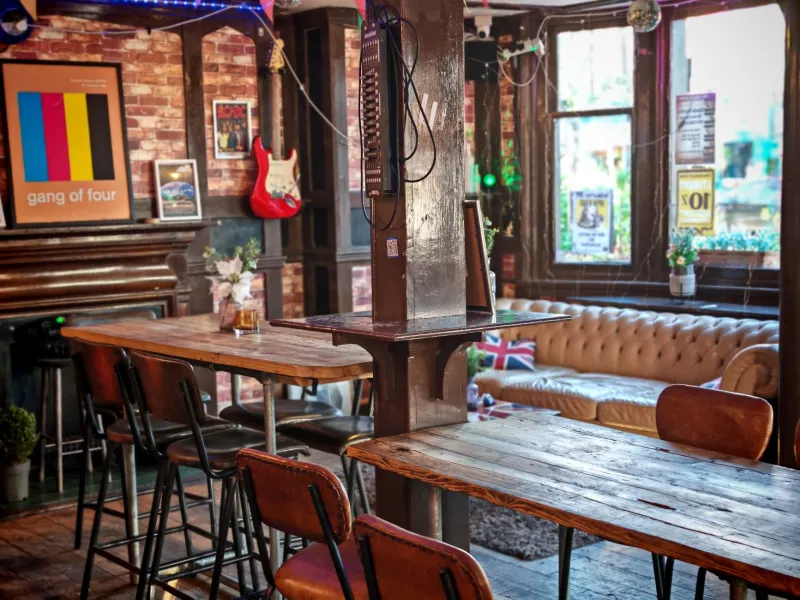
Oldham, 1965. A pub carpet the colour of a bruise, a landlord with a hangman's past, and a room full of people pretending not to watch the door. Hangmen opens with the furniture of English provincial comedy and then quietly locks the exits. It is the play in which Martin McDonagh swaps the mist and myth of the west of Ireland for Lancashire vowels, last orders and the bureaucratic afterlife of capital punishment. More than a decade after its Royal Court premiere in 2015, it remains his most British play — and, for that reason, one of his most misread.
The pub as a courtroom
Harry Wade is not just a landlord. He is a former hangman, reportedly the second-best in England, which is the kind of ranking that only makes sense in a country where professional pride and state killing once shared a stationery cupboard. The joke is not that Harry is a monster. It is that he is a middle-aged man with a trade, a local reputation and a pub to run. When Parliament abolishes capital punishment, his reaction is less moral crisis than professional grievance. The state has made him redundant, and the play finds that funnier — and sadder — than any sermon.
That is the crucial shift. In the Leenane trilogy, McDonagh built his menace out of isolated cottages, family grudges and the sort of rural silence that makes a kettle sound like a threat. Hangmen moves the violence into a public house. The pub is still a stage: people perform their better selves there, and everyone can see the performance. Oldham's provinciality is not a limitation. It is the pressure cooker. The local paper, the quiz, the regulars, the stranger at the bar — all of it turns the play into a study of English hierarchy in a room where nobody can leave without being noticed.
Dialect, menace and the English weather
McDonagh's ear for the violence inside small talk is on full display here, but the music is different. The Irish lilt that audiences expect from him is replaced by the flatter, needling rhythms of northern English speech. The comedy comes from people saying ordinary things with extraordinary weight: a compliment that sounds like a threat, a question that is really a summons, a joke that lands because nobody dares admit it is not funny. It is a play about the English talent for making cruelty sound like good manners.
The setting matters because the historical backdrop is not decorative. The Murder (Abolition of Death Penalty) Act 1965 suspended the death penalty for murder in Britain; it became permanent in 1969. The last executions in Britain had taken place in 1964. Hangmen sits in that narrow historical gap, when the gallows were being packed away and the men who operated them were left to explain themselves to the neighbours. That is a very British kind of trauma: not a revolution, but a change in the paperwork.
Gallows humour is not a bug
British audiences tend to understand Hangmen faster than they can explain it. The play's humour is rooted in a native tradition of laughing at the worst thing in the room because the alternative is to give it a standing ovation. It is not that the play is pro- or anti-capital punishment in any simple sense. It is more interested in the vanity of men who believed they were the state's hand, and in the way ordinary people can discuss an execution as if it were a football result or a change in the licensing laws. The comedy does not soften the horror. It makes the horror domestic.
That is also why the play can feel uncomfortable in a specifically British way. The pub is not just a setting; it is a social contract. To be in a pub is to be watched, judged and occasionally forgiven. When a stranger arrives with a story that does not fit, the room's politeness becomes a form of aggression. McDonagh understands that the most frightening sentence in England is often delivered with a smile and a fresh round.
Why it gets mistaken for a lesser McDonagh
Some audiences come to Hangmen expecting another Irish McDonagh play and find instead a Lancashire one. No turf fire, no rural folklore, no family feud spilling across a cottage floor. Critics who treat Irishness as McDonagh's brand can mistake the play's Englishness for a detour. But Hangmen is not a detour. It is a test of whether his stagecraft works when the mythology is not rural and the accents are not Irish. It does. The play's suspense is bureaucratic and domestic: a man waiting for a knock at the door, a pub waiting for a punchline, a country waiting to see whether it can live without the rope.
What makes it deeply McDonagh is the way the biggest historical event — abolition — becomes a background inconvenience to a man's ego. Harry Wade does not ask whether hanging was right. He asks who is going to respect him now. That is the same dark comic engine that drives the Leenane plays, only dressed in a cardigan and standing behind a bar.
Last orders
The title is a warning. Hangmen is about men who kill for the state, but it is also about the last orders of a certain England: the old certainties, the local pecking order, the pub as a place where the past can be toasted and quietly buried. McDonagh does not sentimentalise any of it. He lets the gallows humour do its work, then leaves the room feeling colder than when you entered. That is not a misunderstanding. That is the trick.