The Last Five Minutes: How Martin McDonagh Ruins Every Other Film's Ending for You
There's a particular feeling you get in the last five minutes of a Martin McDonagh film. It isn't satisfaction. It isn't quite devastation either. It's closer to the sensation of being caught out — like you've been laughing along at a joke and only now, as the lights come up, do you realise the punchline was about you.
Most screenwriters treat endings as an accounting exercise. Questions raised, questions answered, character arcs balanced like a spreadsheet. McDonagh treats them as a verdict. Not on his characters — on you.
The Tower, the Painter, and the Worst Kind of Mercy
Start with In Bruges, still the definitive text. Harry Waters spends the entire film as a cartoon of masculine principle — a London gangster so devoted to his own code that he'd rather die than shoot the wrong person by accident. Then, in the film's final minutes, that code is tested against a minotaur's head and a dwarf in a schoolboy uniform, and Harry loses. Badly.
What's remarkable about the ending isn't the gore. It's the negotiation. Ray, bleeding out on the stretcher, delivers that halting monologue about purgatory: maybe this isn't the end, maybe this is just the in-between. "If I'd have lived in Turkey, and I was a drug mule, and they'd have cut me open with a knife — that would have been a fair trial."
It's a joke. It's also a theology. And McDonagh refuses to tell you which one he means. Compare that to the average British crime caper of the era — Layer Cake, Sexy Beast — which all end with someone either rich, dead, or double-crossed, and the moral ledger firmly closed. McDonagh leaves the ledger open and asks you to sign it.
Three Billboards and the Ambiguity Police
Three Billboards Outside Ebbing, Missouri took more flak than any of his other films, and almost all of it was about the ending. Mildred and Dixon get in a car, heading — possibly — to kill a man who may or may not be the rapist. They agree they might change their minds on the way. Cut to credits.
American critics wanted resolution. Did they do it? Was he the bloke? Give us a name, a face, a courtroom.
But that misses the point entirely. The film's central question was never "who raped Angela Hayes?" — it was "what does grief do to a person when it has nowhere to go?" The ambiguous ending answers that question completely. Grief doesn't resolve. It just gets in the car with you.
There's a very British instinct here, too. We're raised on endings that don't resolve — from the original The Wicker Man to the last episode of The Office UK, where David Brent finally gets a moment of dignity that somehow feels worse than humiliation. McDonagh, though born in Camberwell and raised in Galway, sits firmly in that tradition: the ending as a door left ajar.
The Last Walk on Inisherin
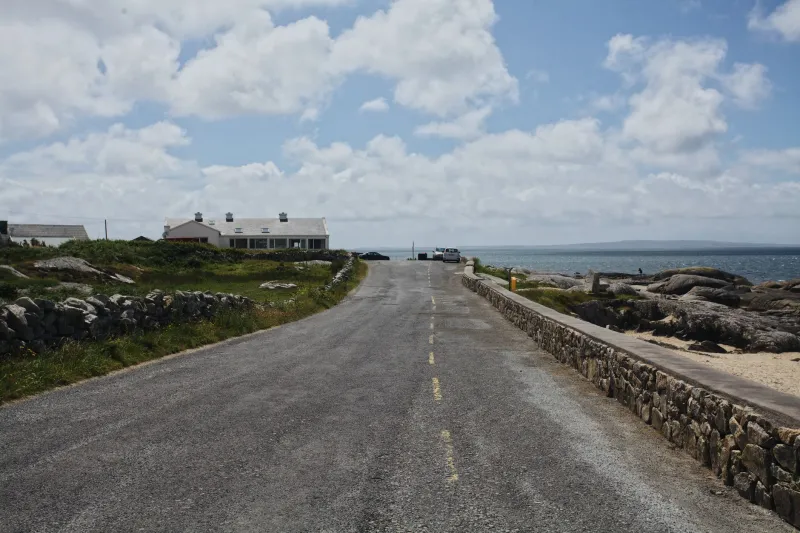
Which brings us to The Banshees of Inisherin, and the most quietly devastating final scene he's ever written. Colm and Pádraic, the friendship destroyed, the feud ended only by death — Colm on the beach, delivering his eulogy for a man who isn't dead yet. "I thank you for the time we had together."
And then Pádraic, standing at the beach's edge, tells him: if you'd have just stayed on your own side of the road, all this wouldn't have happened. Which is a lie, obviously — Pádraic started it, insofar as anyone started it. But the film ends with him walking away, and you realise the thing Colm feared most, mediocrity, has consumed them both. Pádraic isn't evil now. He's just ordinary and cruel, which might be worse.
No film in recent memory has earned its final image more. And no film has been punished by audiences for it more quietly — people walked out of the cinema wanting a reconciliation that McDonagh understood, correctly, would be a lie.
Why He Can't Write It Any Other Way
Here's the thing about McDonagh's plays that explains his films: they were always about the moment after the moment. The Pillowman doesn't end with a trial verdict; it ends with a writer deciding whether his stories were worth the lives they cost. The Beauty Queen of Leenane ends not with a murder but with a monologue delivered to an empty chair.
The ending is never the plot's conclusion. It's the moral's cross-examination.
Other screenwriters — even good ones — treat the final scene as a gift to the audience. McDonagh treats it as an invoice. You laughed at the swearing. You enjoyed the violence. You rooted for people who did terrible things. Right. Now sit with that for a moment while the credits roll.
It's why his films rewatch so strangely. The second time through In Bruges, you're not watching a comedy about hitmen in Belgium. You're watching a man pre-prepare his own purgatory. The first viewing is a night out. The second is an appointment.
So next time someone tells you a film had a "satisfying ending," ask them what they mean. Did the story finish, or did the question get answered? Because in McDonagh's world, those are two entirely different things — and only one of them is worth hanging your hat on.